Defines generic classes and macros to support user data types. More...
Data Structures | |
| struct | FooTypeSupport |
| <<interface>> <<generic>> User data type specific interface. More... | |
| struct | DDS_InstanceHandleSeq |
Instantiates FooSeq < DDS_InstanceHandle_t > . More... | |
Macros | |
| #define | DDS_DATAWRITER_C(TDataWriter, TData) |
| Declares the interface required to support a user data type specific data writer. | |
| #define | DDS_TYPESUPPORT_C(TTypeSupport, TData) |
| Declares the interface required to support a user data type. | |
| #define | DDS_DATAREADER_C(TDataReader, TDataSeq, TData) |
| Declares the interface required to support a user data type-specific data reader. | |
Typedefs | |
| typedef DDS_HANDLE_TYPE_NATIVE | DDS_InstanceHandle_t |
| Type definition for an instance handle. | |
Functions | |
| Foo * | FooTypeSupport_create_data (void) |
| <<cert>> <<eXtension>> Create a data type and initialize it. | |
| DDS_ReturnCode_t | FooTypeSupport_delete_data (Foo *sample) |
| <<eXtension>> Destroy a user data type instance. | |
| DDS_ReturnCode_t | FooTypeSupport_register_type (DDS_DomainParticipant *participant, const char *type_name) |
| <<cert>> Allows an application to communicate to RTI Connext DDS Micro the existence of a data type. | |
| DDS_ReturnCode_t | FooTypeSupport_unregister_type (DDS_DomainParticipant *participant, const char *type_name) |
| Allows an application to unregister a data type from RTI Connext DDS Micro. After calling unregister_type, no further communication using that type is possible. | |
| DDS_ReturnCode_t | FooTypeSupport_serialize_data_to_cdr_buffer_ex (char *buffer, unsigned int *length, const TData *a_data, DDS_DataRepresentationId_t representation) |
| <<eXtension>> Serializes the input sample into a buffer of octets. | |
| DDS_ReturnCode_t | FooTypeSupport_serialize_data_to_cdr_buffer (char *buffer, unsigned int *length, const Foo *a_data) |
| <<eXtension>> Serializes the input sample into a CDR buffer of octets. | |
| DDS_ReturnCode_t | FooTypeSupport_deserialize_data_from_cdr_buffer (Foo *a_data, const char *buffer, unsigned int length) |
| <<eXtension>> Deserializes a sample from a buffer of octets. | |
| DDS_Boolean | DDS_InstanceHandle_equals (const DDS_InstanceHandle_t *self, const DDS_InstanceHandle_t *other) |
| <<cert>> Compares this instance handle with another handle for equality. | |
| DDS_Boolean | DDS_InstanceHandle_is_nil (const DDS_InstanceHandle_t *self) |
| <<cert>> Compare this handle to DDS_HANDLE_NIL | |
Variables | |
| const DDS_InstanceHandle_t | DDS_HANDLE_NIL |
| <<cert>> The NIL instance handle. | |
Detailed Description
Defines generic classes and macros to support user data types.
Defines the DDS user data type support.
DDS specifies strongly typed interfaces to read and write user data. For each data class defined by the application, there is a number of specialized classes that are required to facilitate the type-safe interaction of the application with RTI Connext DDS Micro.
RTI Connext DDS Micro provides an automatic means to generate all these type-specific classes with the RTI IDL Compiler User Manual utility. The complete set of automatic classes created for a hypothetical user data type named Foo are shown below.
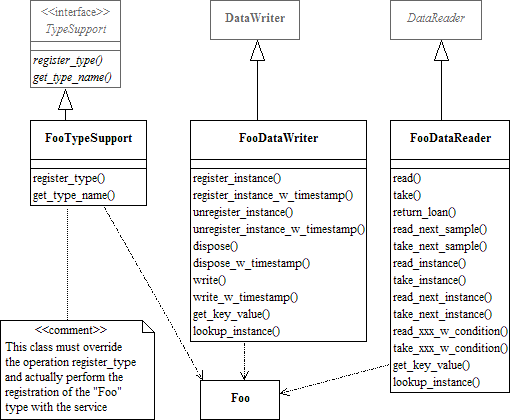
Foo" The macros defined here declare the strongly typed APIs needed to support an arbitrary user defined data of type Foo.
Macro Definition Documentation
◆ DDS_DATAWRITER_C
| #define DDS_DATAWRITER_C | ( | TDataWriter, | |
| TData ) |
Declares the interface required to support a user data type specific data writer.
- Uses:
- FooTypeSupport user data type,
Foo
- Defines:
- FooDataWriter DDS_DataWriter of type
Foo, i.e.FooDataWriter
◆ DDS_TYPESUPPORT_C
| #define DDS_TYPESUPPORT_C | ( | TTypeSupport, | |
| TData ) |
Declares the interface required to support a user data type.
- Defines:
- FooTypeSupport TypeSupport of type
Foo, i.e.FooTypeSupport
◆ DDS_DATAREADER_C
| #define DDS_DATAREADER_C | ( | TDataReader, | |
| TDataSeq, | |||
| TData ) |
Declares the interface required to support a user data type-specific data reader.
- Uses:
- FooTypeSupport user data type,
FooFooSeq sequence of user data type,sequence<Foo>
- Defines:
- FooDataReader DDS_DataReader of type
Foo, i.e.FooDataReader
- See also
- FooSeq
Typedef Documentation
◆ DDS_InstanceHandle_t
| typedef DDS_HANDLE_TYPE_NATIVE DDS_InstanceHandle_t |
Type definition for an instance handle.
Handle to identify different instances of the same DDS_Topic of a certain type.
Function Documentation
◆ FooTypeSupport_create_data()
| Foo * FooTypeSupport_create_data | ( | void | ) |
<<cert>> <<eXtension>> Create a data type and initialize it.
Memory for a data type is allocated from memory using internal RTI Connext DDS Micro memory allocation and deallocation APIs. The implementation of these APIs are specific to a particular platform. For this reason it is of the utmost importance that FooTypeSupport_create_data is not called until DDS_DomainParticipantFactory_get_instance has been called successfully. The DDS_DomainParticipantFactory initializes the RTI Connext DDS Micro system, including any memory management initialization.
The generated implementation of the operation knows how to instantiate a data type and initialize it properly.
All memory for the type is deeply allocated.
- Returns
- newly created data type
- MT Safety:
- This operation is thread safe.
- API Restriction:
- This function must only be called after DDS_DomainParticipantFactory_get_instance.
- See also
- FooTypeSupport_delete_data
◆ FooTypeSupport_delete_data()
| DDS_ReturnCode_t FooTypeSupport_delete_data | ( | Foo * | sample | ) |
<<eXtension>> Destroy a user data type instance.
The generated implementation of the operation knows how to destroy a data type and return all resources.
- Parameters
-
sample <<in>> Cannot be NULL.
- Returns
- One of the Standard Return Codes
- See also
- FooTypeSupport_create_data
◆ FooTypeSupport_register_type()
| DDS_ReturnCode_t FooTypeSupport_register_type | ( | DDS_DomainParticipant * | participant, |
| const char * | type_name ) |
<<cert>> Allows an application to communicate to RTI Connext DDS Micro the existence of a data type.
The generated implementation of the operation embeds all the knowledge that has to be communicated to the middleware in order to make it able to manage the contents of data of that type. This includes in particular the key definition that will allow RTI Connext DDS Micro to distinguish different instances of the same type.
The same DDS_TYPESUPPORT_C can be registered multiple times with a DDS_DomainParticipant using the same or different values for the type_name. If register_type is called multiple times on the same DDS_TYPESUPPORT_C with the same DDS_DomainParticipant and type_name, the second (and subsequent) registrations return DDS_RETCODE_OK. A type must be registered and unregistered an equal number of times.
- Precondition
- Cannot use the same
type_nameto register two different DDS_TYPESUPPORT_C with the same DDS_DomainParticipant, or else the operation will fail and DDS_RETCODE_PRECONDITION_NOT_MET will be returned.
- Parameters
-
participant <<in>> the DDS_DomainParticipant to register the data type Foowith. Cannot be NULL.type_name <<in>> the type name under with the data type Foois registered with the participant; this type name is used when creating a new DDS_Topic. (See DDS_DomainParticipant_create_topic.) The name may not be longer than 255 characters. If name is NULL, the typename specified in IDL is used.
- Returns
- One of the Standard Return Codes, DDS_RETCODE_PRECONDITION_NOT_MET or DDS_RETCODE_OUT_OF_RESOURCES.
- MT Safety:
- This operation is thread safe. However, note that the arguments are not protected from being modified by other threads and must not be modified until the call returns.
◆ FooTypeSupport_unregister_type()
| DDS_ReturnCode_t FooTypeSupport_unregister_type | ( | DDS_DomainParticipant * | participant, |
| const char * | type_name ) |
Allows an application to unregister a data type from RTI Connext DDS Micro. After calling unregister_type, no further communication using that type is possible.
The generated implementation of the operation removes all the information about a type from RTI Connext DDS Micro. No further communication using that type is possible.
- Precondition
- A type with
type_nameis registered with the participant and all DDS_Topic objects referencing the type have been destroyed. If the type is not registered with the participant, or if any DDS_Topic is associated with the type, the operation will fail with DDS_RETCODE_ERROR.
- Postcondition
- All information about the type is removed from RTI Connext DDS Micro. No further communication using this type is possible.
- Parameters
-
participant <<in>> the DDS_DomainParticipant to unregister the data type Foofrom. Cannot be NULL.type_name <<in>> the type name under with the data type Foois registered with the participant. The name should match a name that has been previously used to register a type with the participant. Cannot be NULL.
- Returns
- One of the Standard Return Codes, DDS_RETCODE_BAD_PARAMETER or DDS_RETCODE_ERROR
- MT Safety:
- SAFE.
◆ FooTypeSupport_serialize_data_to_cdr_buffer_ex()
| DDS_ReturnCode_t FooTypeSupport_serialize_data_to_cdr_buffer_ex | ( | char * | buffer, |
| unsigned int * | length, | ||
| const TData * | a_data, | ||
| DDS_DataRepresentationId_t | representation ) |
<<eXtension>> Serializes the input sample into a buffer of octets.
This function serializes a sample into a buffer of octets using the input data representation. See FooTypeSupport_serialize_data_to_cdr_buffer for details.
- Parameters
-
a_data <<in>>. Input sample. Cannot be NULL. buffer <<out>>. Serialization buffer. length <<inout>>. Serialization buffer length. representation <<in>>. Representation used to serialize the data.
- Returns
- One of the Standard Return Codes
◆ FooTypeSupport_serialize_data_to_cdr_buffer()
| DDS_ReturnCode_t FooTypeSupport_serialize_data_to_cdr_buffer | ( | char * | buffer, |
| unsigned int * | length, | ||
| const Foo * | a_data ) |
<<eXtension>> Serializes the input sample into a CDR buffer of octets.
This function serializes a sample into a buffer of octets and it uses CDR as the data representation. Calling this function is equivalent to calling FooTypeSupport_serialize_data_to_cdr_buffer_ex with DDS_AUTO_DATA_REPRESENTATION as the representation.
The input buffer must be big enough to store the serialized representation of the sample. Otherwise, the function will return an error.
To determine the minimum size of the input buffer, the user must call this function with the buffer set to NULL.
- Parameters
-
a_data <<in>>. Input sample. Cannot be NULL. buffer <<out>>. Serialization buffer. length <<inout>>. When bufferis set to NULL, after the function executes,lengthwill contain a buffer size big enough to hold the serialized data. Whenbufferis not NULL,lengthmust contain the size of the input buffer when the function is invoked. After the function executes,lengthwill be updated to contain the actual size of the serialized content, which may be smaller than the size obtained whenbufferis set to NULL.
- Returns
- One of the Standard Return Codes
◆ FooTypeSupport_deserialize_data_from_cdr_buffer()
| DDS_ReturnCode_t FooTypeSupport_deserialize_data_from_cdr_buffer | ( | Foo * | a_data, |
| const char * | buffer, | ||
| unsigned int | length ) |
<<eXtension>> Deserializes a sample from a buffer of octets.
This function deserializes a sample from a CDR buffer of octets.
The content of the buffer generated by the function FooTypeSupport_serialize_data_to_cdr_buffer can be provided to this function to get the sample back.
- Parameters
-
a_data <<in>>. Output sample. Cannot be NULL. buffer <<in>>. Deserialization buffer. Cannot be NULL. length <<in>>. Length of the serialized representation of the sample in the buffer.
- Returns
- One of the Standard Return Codes
◆ DDS_InstanceHandle_equals()
| DDS_Boolean DDS_InstanceHandle_equals | ( | const DDS_InstanceHandle_t * | self, |
| const DDS_InstanceHandle_t * | other ) |
<<cert>> Compares this instance handle with another handle for equality.
- Parameters
-
self <<in>> This handle. Cannot be NULL. other <<in>> The other handle to be compared with this handle. Cannot be NULL.
- Returns
- DDS_BOOLEAN_TRUE if the two handles have equal values, or DDS_BOOLEAN_FALSE otherwise.
- MT Safety:
- UNSAFE. This operation does not protect against the left or right side from being modified by another thread while the comparison is made.
- See also
- DDS_InstanceHandle_is_nil
◆ DDS_InstanceHandle_is_nil()
| DDS_Boolean DDS_InstanceHandle_is_nil | ( | const DDS_InstanceHandle_t * | self | ) |
<<cert>> Compare this handle to DDS_HANDLE_NIL
- Returns
- DDS_BOOLEAN_TRUE if the given instance handle is equal to DDS_HANDLE_NIL or DDS_BOOLEAN_FALSE otherwise.
- See also
- DDS_InstanceHandle_equals
Variable Documentation
◆ DDS_HANDLE_NIL
|
extern |
<<cert>> The NIL instance handle.
Special DDS_InstanceHandle_t value
- See also
- DDS_InstanceHandle_is_nil