|
RTI Connext Java API
Version 6.0.1
|
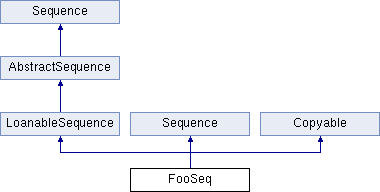
<<interface>> <<generic>> A type-safe, ordered collection of elements. The type of these elements is referred to in this documentation as com.rti.ndds.example.Foo.
More...
Public Member Functions | |
| Object | copy_from (Object src) |
 Public Member Functions inherited from LoanableSequence Public Member Functions inherited from LoanableSequence | |
| LoanableSequence (Class elementType) | |
| Construct a new sequence for elements of the given type. | |
| LoanableSequence (Class elementType, int maximum) | |
| Construct a new sequence for elements of the given type. | |
| LoanableSequence (Class elementType, Collection elements) | |
| Construct a new sequence for elements of the given type. | |
| final boolean | hasOwnership () |
| Return the value of the owned flag. | |
| int | getMaximum () |
| Get the current maximum number of elements that can be stored in this sequence. | |
| void | setMaximum (int new_max) |
| Resize this sequence to a new desired maximum. | |
| Object | set (int index, Object element) |
| Replaces the element at the specified position in this sequence with the specified element. | |
| Object | get (int index) |
| Returns the element at the specified position in this sequence. | |
| int | size () |
| Returns the length of the sequence. | |
| Public Member Functions inherited from AbstractSequence | |
| void | add (int index, Object element) |
| Inserts the specified element at the specified position in this sequence. | |
| boolean | add (Object element) |
| Appends the specified element to the end of this sequence. | |
| final Object | remove (int index) |
| Remove the element at the given index by shifting all subsequent elements "left" by one. | |
| Public Member Functions inherited from Sequence | |
| int | getMaximum () |
| Get the current maximum number of elements that can be stored in this sequence. | |
| void | setMaximum (int new_max) |
| Resize this sequence to a new desired maximum. | |
| Class | getElementType () |
<<interface>> <<generic>> A type-safe, ordered collection of elements. The type of these elements is referred to in this documentation as com.rti.ndds.example.Foo.
For users who define data types in OMG IDL, this type corresponds to the IDL express sequence <Foo>.
For any user-data type Foo that an application defines for the purpose of data-distribution with RTI Connext, a FooSeq is generated. We refer to an IDL sequence <Foo> asFooSeq.
A sequence is a type-safe List that makes a distinction between its allocated size and its logical size (much like the ArrayList class). The Collection.size() method returns the logical size.
A new sequence is created for elements of a particular Class, which does not change throughout the lifetime of a sequence instance.
To add an element to a sequence, use the add() method inherited from the standard interface java.util.List; this will implicitly increase the sequence's size. Or, to pre-allocate space for several elements at once, use com.rti.dds.infrastructure.com.rti.dds.util.Sequence.Sequence.setMaximum.
An attempt to add an element to a sequence that is not of the correct element type will result in a ClassCastException. (Note that null is considered to belong to any type.)
| Object copy_from | ( | Object | src | ) |
Copy data into this object from another. The result of this method is that both this and src will be the same size and contain the same data.
| src | The Object which contains the data to be copied |
this | NullPointerException | If src is null. |
| ClassCastException | If src is not a Sequence OR if one of the objects contained in the Sequence is not of the expected type. |
 RTI Connext Java API Version 6.0.1
Copyright © Sat Nov 23 2019
Real-Time Innovations, Inc
RTI Connext Java API Version 6.0.1
Copyright © Sat Nov 23 2019
Real-Time Innovations, Inc

