1. Before You Get Started
1.1. What is Connext Drive?

RTI® Connext Drive® is RTI’s automotive grade communication framework, enabling the automotive ecosystem to comply with the portability, evolvability, flexibility, and integrability requirements of the industry. Built on the proven Data Distribution Service™ (DDS) standard, Connext Drive provides an abstraction layer that eases development by hiding hardware and OS-specific details. It provides tools and software services to help build automotive software components for all stages of the development cycle, from research to production.
Connext Drive provides the safety and security needed to build for the future while being the only framework supporting AUTOSAR and ROS2. In this bundle, you will experience how Connext Drive enables automakers to quickly and easily meet the most complicated demands of the automotive market to power next-generation vehicles, such as:
Bridging legacy platforms and new technologies to create a Next-Generation E/E Architecture;
Integrating complex data sources for sensor fusion and high performance computing applications in autonomous systems;
Orchestrating safety functionality over ethernet;
Connecting to off-vehicle systems for real-time, including remote operations and telemetry.
Connext Drive includes these components:
SDKs that provide you with APIs to help you send and receive data using communication patterns based on the Data Distribution Service™ (DDS) standard.
Tools that help you visualize your data and debug your distributed system.
Infrastructure Services that can perform dedicated functions in your system, such as routing, recording, and replaying data.
1.2. Bundle Overview
To support both non-safety and safety-critical use cases, the Connext Drive bundle contains the following:
Connext Professional 7.3.0 LTS: RTI’s full-featured, industrial-grade libraries designed to meet the demanding connectivity requirements of autonomous systems. Connext Professional enables rapid development, deployment, and upgrades of widely-distributed teleoperation applications. Find links to the documentation in the README.html file in your installation or on the 7.3.0 RTI Community Portal online.
Connext AUTOSAR Integration Toolkit for AUTOSAR Classic: RTI’s code generation tool that supports automatic conversion of data type definitions across standard formats (OMG IDL, OMG DDS-XML and AUTOSAR ARXML), as well as the generation of supporting C code for data conversion and marshaling between the RTE and DDS communication frameworks. The toolkit includes Connext AUTOSAR Runtime CDD Code Generator 3.1.0. See the AUTOSAR Runtime CDD Code Generator User’s Manual. (This tool/document is not included in LM or evaluation bundles, but you can find information online here.)
Connext Integration Toolkit for AUTOSAR Adaptive: RTI’s code generator for application-specific DDS Network Binding assets plus a source library implementing the AUTOSAR Communications Management DDS Network Binding. The toolkit includes the following components:
Connext AUTOSAR Runtime Adaptive Code Generator 3.1.0. See the AUTOSAR Runtime Adaptive Code Generator User’s Manual. (This tool/document is not included in LM or evaluation bundles, but you can find information online here.)
Connext DDS Network Binding Library 3.1.0. See the DDS Network Binding Library Manual 3.1.0. (This tool/document is not included in LM or evaluation bundles, but you can find information online here.)
Connext DDS Network Binding for Vector MICROSAR Adaptive 3.1.0. (This tool/document is provided as a separately downloadable package; find more information here.)
Connext Micro 2.4.14.2: RTI’s libraries optimized for environments with size, weight, and power constraints. See the Connext Micro User’s Manual in your installation (in
<$NDDSHOME>/rti_connext_dds-<connext-professional-version>/rti_connext_dds_micro-<connext-micro-version>) or look here.See Safety-Certified Libraries below to learn how Connext Micro supports programs with safety requirements.
1.3. Safety-Certified Libraries
For programs with safety requirements, RTI offers libraries that have been safety-certified to ISO 26262 ASIL D—the most stringent automotive functional safety level. These libraries and safety evidence are available for purchase as an add-on product, Connext Cert, RTI’s safety-certified framework.
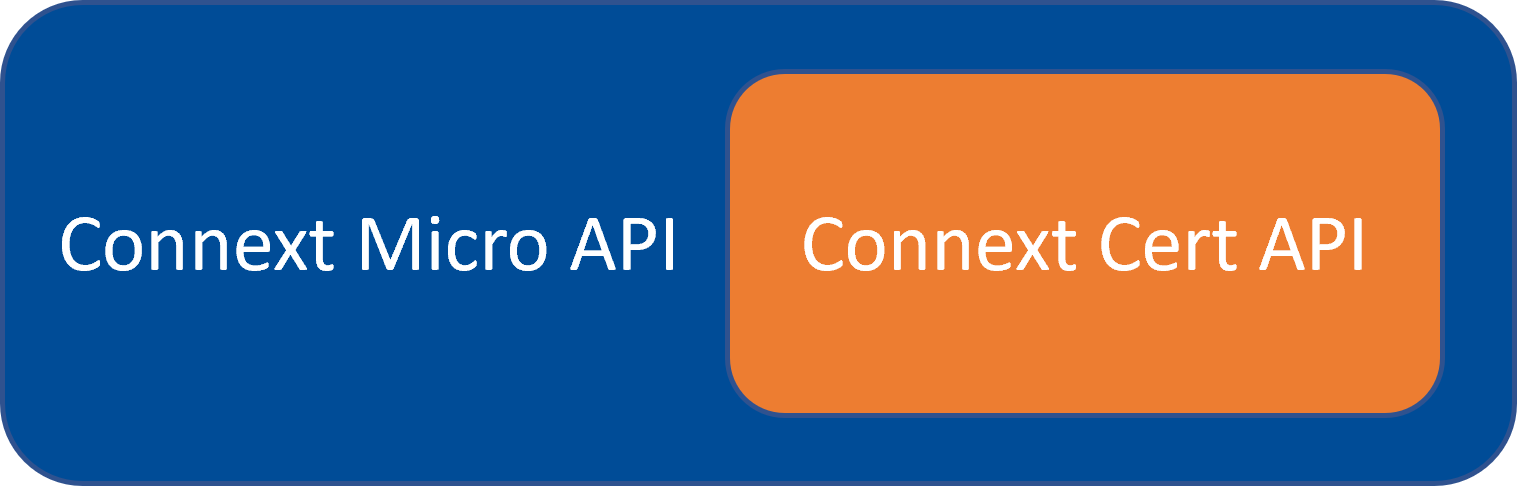
Connext Cert is built from the same code base as Connext Micro, but only uses
a subset of the features and APIs available in Connext Micro. Look for the <<cert>>
tag in the Connext Micro API Reference
to view the features available in Connext Cert. Engineers can begin
experimentation and development work with the standard Connext Micro product, which
is included in the Connext Drive host bundle under
<$NDDSHOME>/rti_connext_dds-<connext-professional-version>/rti_connext_dds_micro-<connext-micro-version>.
In the LM or evaluation Connext Drive bundles (with lm or eval in their name,
such as rti_connext_drive-<connext-drive-version>-lm-x64Win64VS2017.exe),
Connext Micro has been built only with the features available in Connext Cert,
and is included as a binary library and header files to give an accurate
representation of the functionality and performance available within Connext Cert.
Prebuilt Connext Micro libraries with the features avaliable in Connext Cert are
provided for the following two target architectures in the LM/eval Connext Drive
bundles:
armv8Linux4gcc7.3.0CERT
x64Linux4gcc7.3.0CERT
If you installed a regular (non-LM/non-eval) Connext Drive bundle, you will need to compile your own cert-profile libraries. See Hands-On 3: Getting Started with the Safety-Critical SDK.
For additional questions or guidance around RTI’s safety libraries, please contact your sales representative.